
Industrial equipment
Welding Positioner
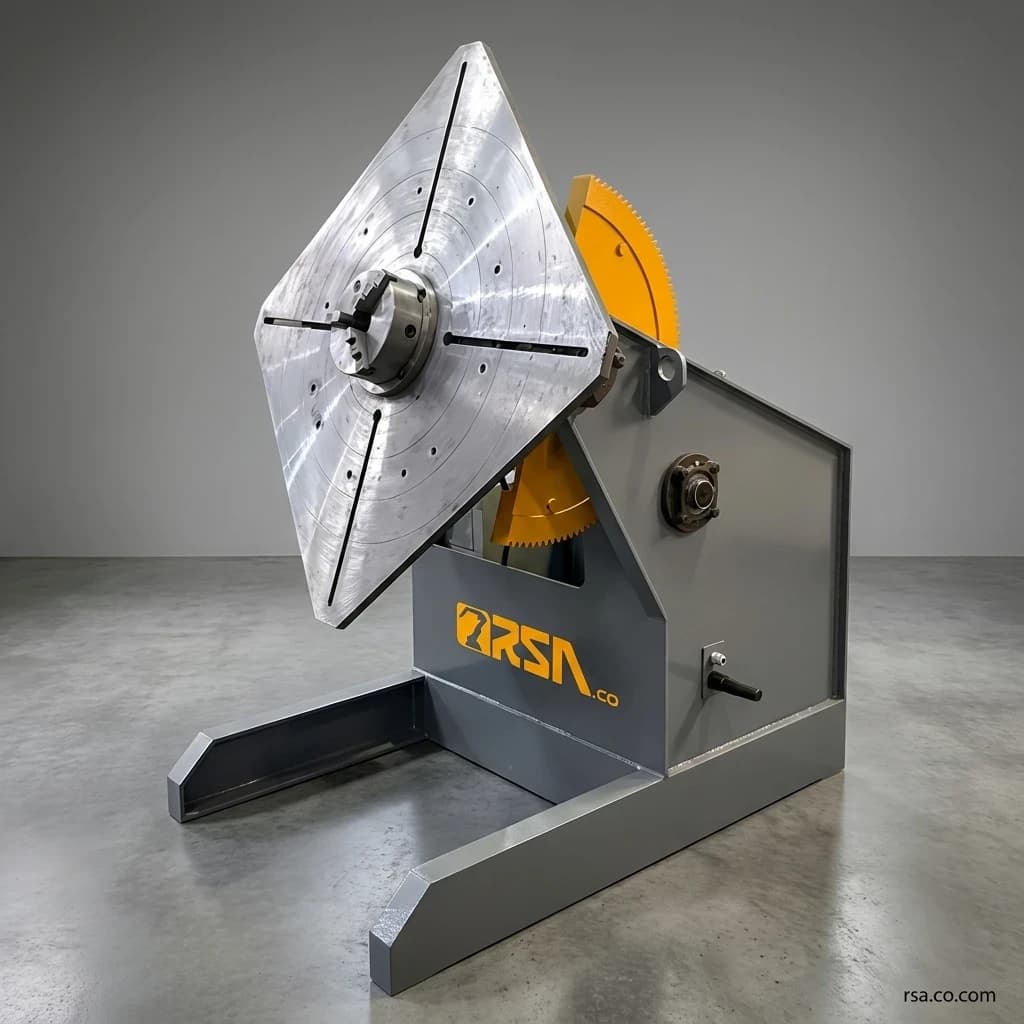
A welding positioner rotates and tilts workpieces into an accessible welding position. Controlled movement helps operators produce more consistent welds while reducing handling time.
Talk to an engineerFull description
A welding positioner holds, rotates and tilts a workpiece during welding and assembly. It helps the operator reach the joint and place the part at the required angle while rotating it at a controlled speed.
RSA supplies welding positioners in various sizes and capacities. Workpiece weight is only one selection factor: fixture weight, workpiece dimensions, center of gravity and required rotation speed must also be considered. The model data below and the selection guidance can help you prepare a technical inquiry.
Key Features
Accommodates workpieces of different shapes
Inverter-controlled rotation speed
Tilts from 10 degrees below horizontal to 120 degrees
Automatically locks at the selected tilt angle
Graduated worktable with T-slots for mounting workpieces
Relatively lightweight structure that is easy to move
Remote control
Provision for connecting welding equipment
Model Dimensions
MODEL | A (mm) | B (mm) | C (mm) | D (mm) | E (mm) |
|---|---|---|---|---|---|
RPM0350 | 1000 | 740 | 1120 | Φ750 | 750 |
RPM1000 | 1500 | 1000 | 1600 | Φ1000 | 1100 |
RPM5000 | 2300 | 1600 | 2550 | 1300*1300(Φ1700) | 1900 |
RPM10000 | 2300 | 1600 | 2550 | 1300*1300(Φ1700) | 1900 |
RPM15000 | 2500 | 300 | 3000 | 1600*1600(Φ2000) | 2200 |
Technical Specifications
MODEL | Load capacity(KG) | Rotation speed(RPM) | Tilting time | T-slots for bolts |
|---|---|---|---|---|
RPM0350 | 350 | 0.2 ~ 1 | 120°/20 sec | M16 |
RPM1000 | 1000 | 0.2 ~ 1 | 120°/30 sec | M16 |
RPM5000 | 5000 | 0.1 ~ 0.6 | 120°/80 sec | M20 |
RPM10000 | 10000 | 0.1 ~ 0.6 | 120°/100 sec | M24 |
RPM15000 | 20000 | 0.1 ~ 0.6 | 120°/120 sec | M24 |
A positioner supports and rotates the workpiece so a welder can work at a suitable angle on a stable joint. Even with heavy loads, it can turn at a consistent speed. The aim is to keep the joint in a practical welding position throughout the operation.
How Welding Positioners Improve Productivity
Positioners reduce time lost to repeatedly moving and supporting a workpiece. Cranes, chains and hooks often require considerable personnel and effort to hold a part in a suitable welding position. A positioner can support and reposition it more efficiently, reducing handling time and labor and improving production throughput.
Improving Weld Quality
Stable workpiece positioning supports consistent weld quality. Unwanted movement can disrupt welding, while a securely held part gives better access and helps maintain penetration and continuity. A positioner rotates the workpiece at an appropriate, controlled speed to help produce a continuous weld.
Welder Comfort and Safety
Retaining and training skilled welders matters to manufacturers. A positioner can improve working posture and let welders work with less manual handling and fatigue. Benefits may include:
Improved workplace safety
Better access for high-quality circumferential welds
Improved operator comfort and morale
Support for semi-automated work with less physical strain
Important Considerations When Using a Positioner
Workpiece Center of Gravity (COG)
The center of gravity is the point through which the workpiece weight acts. Determine its location before choosing a positioner so the machine can support and rotate the actual workpiece and fixture safely.
Securing the Workpiece Correctly
The workpiece must be secured on the table while remaining practical to clamp before welding and release afterward. Select the method according to shape and weight. A suitable chuck may hold cylindrical parts such as flanges and pipes; other parts may need to be bolted directly to the table.
Where Are Welding Positioners Used?
Industrial production joins metal parts of many sizes and shapes. Small parts may be welded with simple equipment, but large, heavy assemblies become difficult when they must be turned and welded from several directions. Dedicated positioning equipment makes these tasks more practical.
A positioner lets welders place a workpiece at the required angle and improve joint access. Machines of different sizes and capacities can be selected to meet project requirements and increase production capability.
Positioners are used wherever parts of different sizes and weights are welded or assembled. Common applications include:
Rotational positioning of components
Turning workpieces during assembly
Welding shafts, wheels, pipes and other cylindrical parts
Positioning components with hard-to-reach welds
Types of Welding Positioner
A typical positioner moves the workpiece in two ways: rotation around the table axis and tilting around the machine pivot. Rotation can provide travel during welding; tilting improves access. By tilt mechanism, positioners are commonly built with mechanical or hydraulic drives.
Mechanical Welding Positioner
In a mechanical positioner, a pinion and gear mechanism tilts the worktable.
Hydraulic Welding Positioner
In a hydraulic positioner, cylinders provide the tilting motion. Hydraulic systems are commonly considered when workpiece loads are higher than those suited to a standard mechanical arrangement.
Welding Positioner Pricing
As with other industrial equipment, price depends on configuration and intended duty. Relevant factors include:
Application and performance: Demanding welding projects require more capable designs and may cost more.
Level of automation: Advanced automatic controls may improve accuracy and speed and usually cost more than manual or semi-automatic configurations.
Build quality: Materials and manufacturing methods affect both price and service life. Better construction can cost more initially but last longer.
Output torque: Mechanical capability, including available torque, affects the size and weight of workpiece the machine can handle.
Import costs and duties, exchange rates, warranty terms and after-sales support may also affect the final price where applicable.
Guide to Buying a Used Welding Positioner
Verify operation: Inspect the technical and operational condition carefully. Many positioners have handled heavy industrial work, so the strength and durability of major components matter.
Check rotation and positioning: Confirm that rotation and tilt systems operate correctly and accurately hold selected positions. Review maintenance and service history.
Test major components: Check the mounting surface, stability of moving parts and ability to hold the load during welding. Test the motor and gearbox. Scratches, corrosion or external damage may indicate hard use or poor maintenance.
Buying a used positioner requires care. Consult experienced technicians and, if possible, test the machine at the seller’s site. Its condition and fitness for your work determine its value.
Why Work with RSA?
Engineers and specialists with more than 20 years of industrial experience
Quality materials and equipment from established suppliers
Years of cooperation with major industrial companies across Iran
Responsive pre-sales and after-sales service
Why Choose an RSA Welding Positioner?
Mounts workpieces of different shapes
Inverter-controlled rotation speed
Tilts from 10 degrees below horizontal to 120 degrees
Automatic lock at the selected tilt angle
Graduated worktable with T-slots for easier mounting
Portable, relatively lightweight structure
Remote control
Provision for connecting welding equipment
Comments (0)
No comments yet.
Leave a comment
Comments and replies appear after moderator review.