
Industrial equipment
Fit-Up Welding Rotator
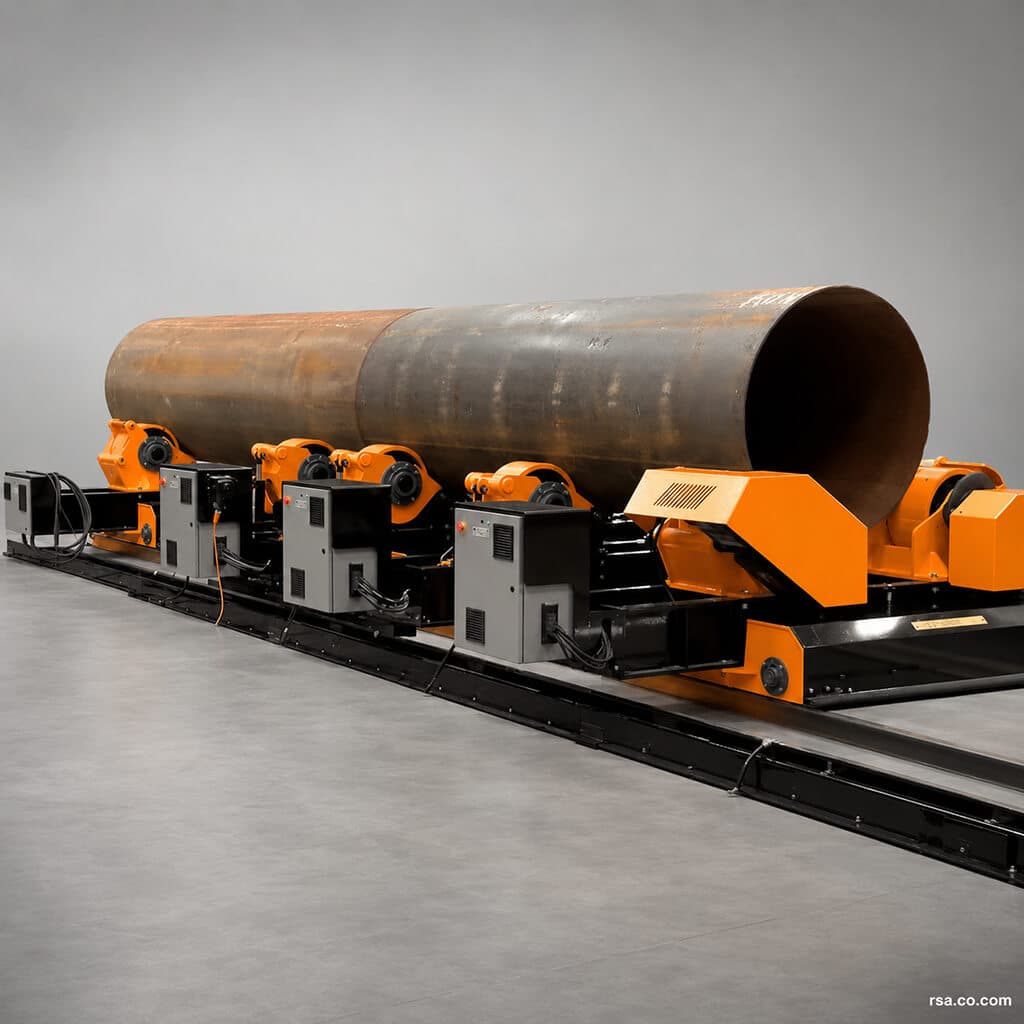
A fit-up rotator supports, aligns, brings together, and rotates heavy cylindrical vessel sections during assembly and welding. RSA offers project-specific systems in 40, 70, 100, 150, and 250-tonne models.
Talk to an engineerFull description
A fit-up welding rotator supports, aligns, brings together, assembles, and rotates heavy cylindrical shells and sections before and during vessel welding. It is particularly useful when accurate shell-to-shell, shell-to-head, or sequential multi-section assembly is required. Instead of relying on repeated crane moves, jacks, and manual adjustments for every positioning step, a fit-up line gives operators more control over section position on the production line.
RSA fit-up rotators can be designed and built for project requirements in 40, 70, 100, 150, and 250-tonne capacity classes.
Fit-Up Rotator Features
- Alignment and assembly of cylindrical shells.
- Integration with welding rotators of different capacities.
- Hydraulic adjustment of fit-up unit position and height.
- Longitudinal travel of a movable unit on rails.
- Configuration as a staged assembly or growing line.
- Rotation for tack welding and circumferential welding.
- Possible integration with a welding column and boom.
- Reduced need for repeated crane moves during assembly.
- Optional polyurethane-coated rollers where suitable.
- Custom design for workpiece weight, diameter, and length.
- Applications involving pressure vessels, large pipes, petrochemical equipment, and other cylindrical structures.
- Line length selected for the project and available factory space.
Fit-Up Rotator Technical Specifications
| Model | Roller bed | Load capacity | Rotation speed | H | D1 | D2 |
|---|---|---|---|---|---|---|
| RBF40 | RBS40 | 40,000 kg | 12–60 cm/min | 150 mm | Ø7,000 mm | Ø2,000 mm |
| RBF70 | RBS70 | 70,000 kg | 12–60 cm/min | 150 mm | Ø7,000 mm | Ø2,000 mm |
| RBF100 | RBS100 | 100,000 kg | 15–70 cm/min | 150 mm | Ø7,500 mm | Ø2,100 mm |
| RBF150 | RBS150 | 150,000 kg | 15–70 cm/min | 150 mm | Ø9,000 mm | Ø2,400 mm |
| RBF250 | RBS250 | 250,000 kg | 15–70 cm/min | 150 mm | Ø10,000 mm | Ø2,800 mm |
A suitable model cannot be selected from the weight of one shell alone. Assess the maximum weight of the completed assembly, diameter, section length, load distribution, number of support points, and movement conditions. The precise diameter range and arrangement for a project must be confirmed against its drawings and specification.
What Is Vessel Fit-Up?
Fit-up is the positioning of two cylindrical parts or sections relative to one another before final welding. Their axes must be aligned, edge mismatch corrected, joint gap set to the project requirement, and the parts held ready for tack welding and final welding. A conventional rotator mainly supports and turns a vessel; a fit-up system also adjusts section position for assembly. It can therefore form part of a vessel assembly and welding line.
What Is a Growing Line?
A growing line builds long vessels, pipes, towers, or other cylindrical structures by adding sections in stages. Two sections are positioned, aligned, tack welded, and welded. The assembled length is then moved along the line to make room for the next section. This reduces repeated crane repositioning, though cranes may still be needed for loading and unloading.
The number of sections and final product length are not unlimited. Rail length, equipment capacity, cumulative workpiece weight, support points, shell strength, available hall space, and center of gravity set the practical limits.
Main Components
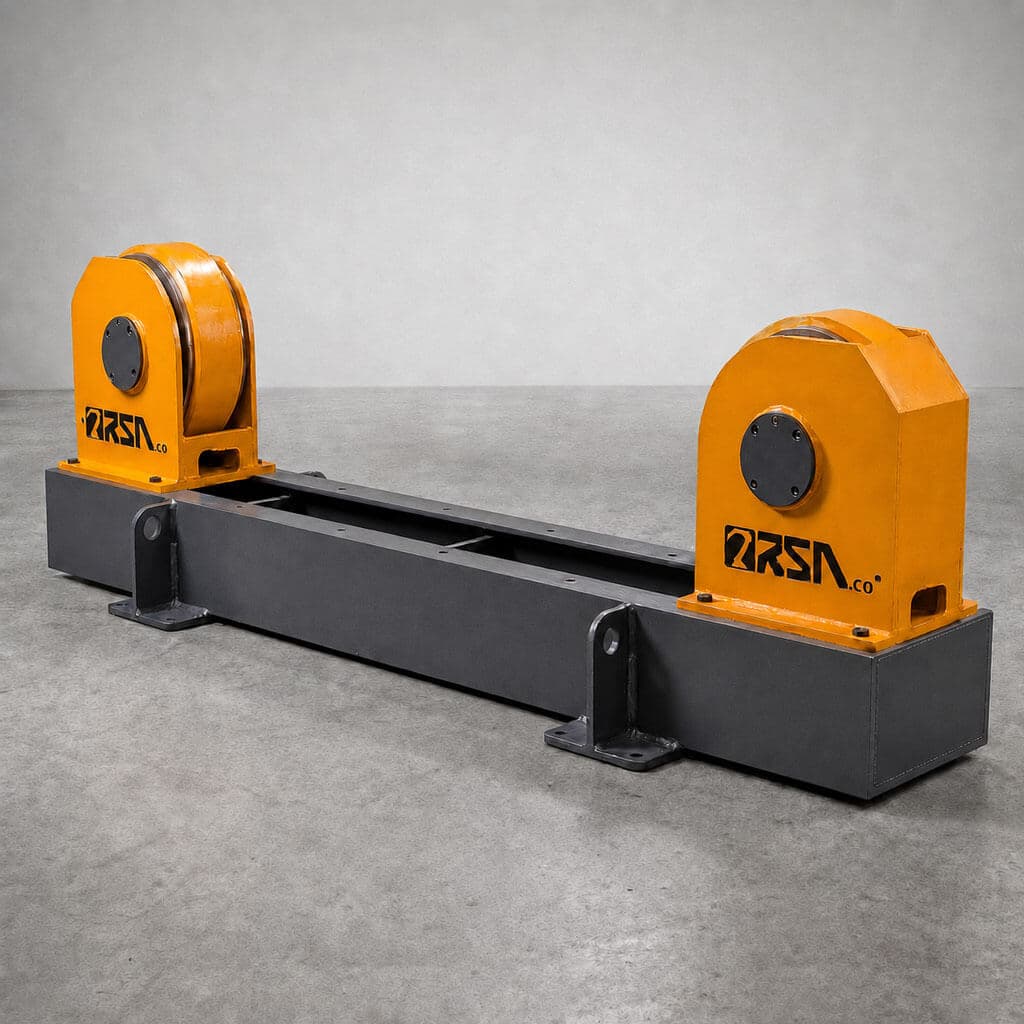
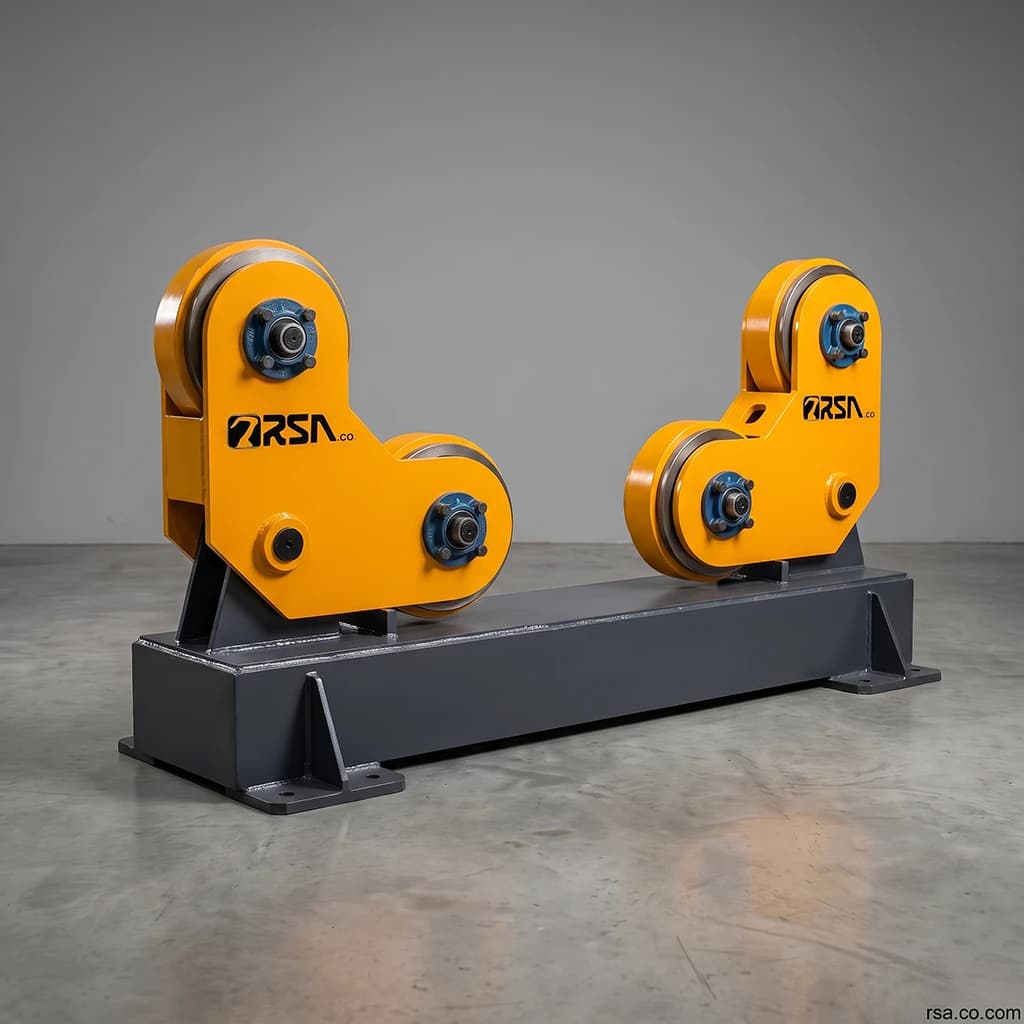
Drive rotator
The drive rotator turns the workpiece at a controlled speed so the circumference can be reached for alignment, tack welding, and welding. Its motor, gearbox, drive system, and speed range are selected for the project.
Idler rotator
Idler units support part of the vessel weight and turn with it. The required number depends on workpiece length, weight, shell stiffness, and load distribution.
Fixed fit-up unit
The fixed unit supports a section or the growing assembly at a defined station. Hydraulic adjustment of support height or position may still be available; “fixed” means its main frame does not travel along the rail.
Movable fit-up unit
The movable unit supports and adjusts a section while traveling along the rail. It can bring sections together, prepare the joint, move the growing assembly, and clear space for the next section.
Hydraulics, rails, and controls
Hydraulics provide controlled adjustment under load. Working pressure, cylinder count and stroke, power-unit capacity, circuits, and valves are selected for the design. Rails guide axial movement; their length must allow for section size, finished length, loading, welding equipment, crane travel, and unloading.
How a Fit-Up Rotator Works
1. Load the sections
Place two cylindrical sections on their assigned units with suitable lifting equipment. Check contact points, stability, weight distribution, and travel clearance before releasing the crane.
2. Bring the sections together
Move the traveling unit along the rail to establish the required joint preparation gap.
3. Adjust and align
Use the hydraulic adjustments to position the joint edges within drawing, welding-procedure, or project tolerances. Operators and quality personnel must measure and confirm alignment; the machine does not guarantee automatic alignment without measurement.
4. Tack weld
Secure the joint with tack welds. Rotate the vessel as needed to reach different points around its circumference.
5. Weld the circumferential joint
After fit-up, turn the vessel at a speed coordinated with the chosen manual or mechanized welding process.
6. Transfer and extend
Move the joined assembly along the rail, load the next section, and repeat positioning, alignment, tack welding, and joining until the required length is reached.
Hydraulic Adjustment and Circumferential Welding
Hydraulics can change the position or height of a heavily loaded section in a controlled way. Successful fit-up still depends on suitable machine design, shell manufacturing accuracy, operator adjustment, measuring tools, and quality control. Once aligned, the rotator provides steady circumferential movement. It may be paired with a welding column and boom, a submerged arc welding system, or other mechanized welding equipment when their controls and speed ranges are coordinated.
Integration with a Column and Boom
In a mechanized vessel line, the fit-up equipment positions and assembles the sections, the rotator turns the vessel, and a column-and-boom manipulator positions the welding head. After welding, the assembly can advance along the growing line to receive another section.
Wind Turbine Towers and Other Applications
A growing line can support staged fabrication of steel wind turbine tower sections, subject to verification of diameter, geometry, plate thickness, length, weight, and load distribution for the chosen machine. Other potential applications include shell-to-shell and shell-to-head assembly, pressure and storage vessels, large industrial pipe, refinery and petrochemical equipment, power-plant equipment, boilers, some heat exchangers, silos, and mechanized welding of cylindrical structures. Suitability for each workpiece must be confirmed from its actual dimensions and process.
Benefits
- Less repeated crane repositioning, although lifting equipment is still needed for initial loading, unloading, and some other tasks.
- More controlled section positioning under load.
- Staged assembly of long vessels without placing every shell on the line at once.
- Controlled rotation for mechanized welding.
- A linear layout that can reduce crosswise workpiece transfers where space permits.
- Less heavy manual adjustment through hydraulic and rail movement.
Length and Diameter Limits
The growing line can be extended for a project, but it cannot support unlimited vessel length. Rail length, capacity, accumulated weight, support spacing, shell strength, center of gravity, and factory space determine the limit. Every machine also has a supported diameter range set by its geometry. The listed RSA models span approximate diameter ranges between 2 and 10 metres depending on model; the exact range must be confirmed for the selected configuration.
Polyurethane and Steel Rollers
Polyurethane-coated rollers may reduce direct metal-to-metal contact with the vessel and suit some surface-sensitive workpieces. Selection must account for load, surface temperature, oil and chemicals, sharp edges, weld spatter, and contact pressure. Steel rollers may be more suitable in certain very heavy applications. Neither material is best for every job.
Roller Material Comparison
| Criterion | Steel rollers | Polyurethane-coated rollers |
|---|---|---|
| Workpiece contact | Metal to metal | Through PU coating |
| Heavy-duty performance | High, depending on design | Depends on coating specification |
| Sensitivity to sharp edges | Lower | Higher |
| Sensitivity to heat | Depends on design | Usually higher |
| Vessel surface protection | Lower | Better when application is suitable |
| Very heavy loads | Can be evaluated | Capacity must be verified |
Conventional, Self-Aligning, and Fit-Up Rotators
| Feature | Manual-adjustment rotator | Self-aligning rotator | Fit-up rotator |
|---|---|---|---|
| Support the vessel | Yes | Yes | Yes |
| Rotate the vessel | Yes | Yes | Yes |
| Adapt to different diameters | Manual adjustment | Self-aligning | Depends on system design |
| Position shells for assembly | Limited | Not its primary purpose | Yes |
| Hydraulic height adjustment | Usually no | Usually no | Yes |
| Bring sections together | No | No | Yes |
| Longitudinal rail movement | Depends on order | Depends on order | Important for a growing line |
| Suitable for a growing line | No | Not by itself | Yes |
| Primary purpose | Rotation | Rotation of different diameters | Section assembly and fit-up |
If the task is only to rotate one vessel, a complete fit-up system may be unnecessary. A growing line becomes more relevant when multiple shells are assembled sequentially into a long cylindrical product.
Selecting the Right Capacity
Total weight
Calculate the heaviest assembly at every stage, not just the weight of one shell.
Diameter and geometry
Provide minimum and maximum diameters and complete drawings for tapered or varying-diameter sections.
Section length, shell stiffness, and supports
Section length and finished length affect rail design, working space, and support count. Long or thin-walled shells may need additional supports even at lower weights to limit deformation.
Center of gravity and welding process
Nozzles, flanges, heads, and attached equipment can shift the center of gravity. Define the welding process, required rotation speed, and any column-and-boom equipment from the outset.
Information Needed for an Order
- Maximum assembled weight and weight of each section.
- Minimum and maximum diameters, section lengths, final length, and plate thickness.
- Part drawings, including tapered sections.
- Welding process and required rotation speed.
- Preferred roller material and operating environment.
- Available hall space, rail length, crane route and capacity, and electrical supply.
- Requirements for a column and boom or other welding equipment.
Safety and Maintenance
These systems may handle workpieces weighing tens or hundreds of tonnes. Before operation, verify roller support, permissible capacity, load distribution, hydraulic condition, rails, control system, cables, emergency stops, and a clear travel path. Keep personnel clear of the space between sections, below the workpiece, between vessel and rollers, and in the rail unit’s path. Stop and secure the machine and workpiece and isolate energy before maintenance or adjustment.
A maintenance program should inspect rollers and coatings, bearings, gearboxes, motors, drives, rails and traveling wheels, hydraulic cylinders, hoses and connections, the power unit, electrical cabinet, cables, and emergency-stop system. Investigate leaks, unusual noise, heat, vibration, or wear before continuing operation. Use component manuals to determine lubricants and service intervals.
Pricing and Custom Manufacture
Price depends on capacity, diameter range, rail length, section dimensions, number of supports and drive/idler units, hydraulic cylinders and stroke, roller material, motors and gearboxes, speed controls, rail travel, remote operation, safety equipment, welding integration, and customization. Nominal tonnage alone is insufficient for a price. RSA can design the system around the actual production line, including rotators, fit-up units, hydraulics, and rail movement.
When purchasing, assess actual assembled weight, adjustment travel, support count, rotation speed, roller selection, welding-equipment compatibility, and service requirements as well as initial cost.
Available RSA Models
- RBF40 — 40-tonne capacity.
- RBF70 — 70-tonne capacity.
- RBF100 — 100-tonne capacity.
- RBF150 — 150-tonne capacity.
- RBF250 — 250-tonne capacity.
Provide workpiece weight, diameter range, length of each section and the final product, plate thickness, and welding process so the suitable line configuration can be evaluated.
Frequently Asked Questions
What is a fit-up welding rotator?
It supports, positions, brings together, aligns, and rotates cylindrical sections during vessel assembly and welding.
How does it differ from a conventional rotator?
A conventional rotator mainly supports and turns a vessel. A fit-up system also adjusts the position of sections and brings them together for assembly.
What is a growing line?
It assembles a long cylindrical product one section at a time. The joined assembly moves forward to make space for the next section.
Does it replace the crane entirely?
No. It can reduce repeated crane moves, but lifting equipment may still be needed for loading, unloading, and other tasks.
Which capacities are available?
The listed RSA models are 40, 70, 100, 150, and 250 tonnes.
Which diameters can it handle?
Depending on the model, the listed approximate range extends from 2 to 10 metres. Confirm the exact range for the selected configuration.
Is vessel length unlimited?
No. Rail length, equipment capacity, support points, workpiece weight and stiffness, and factory space define the practical limit.
Does it have hydraulic adjustment?
The described system uses hydraulics to adjust fit-up units. The exact motions and cylinder strokes depend on the model and project design.
Can it be used with automatic welding?
Yes, it can be integrated with a column and boom or other mechanized welding equipment when the control systems and rotation speed are designed together.
Can it be used for wind turbine towers?
A growing line may be applicable, provided the selected equipment is verified against the sections’ weight, diameter, geometry, and other properties.
Are polyurethane rollers better than steel rollers?
Neither is universally preferable. Select according to load, temperature, surface sensitivity, operating conditions, and required capacity.
What is needed for a quotation?
Provide maximum weight, diameter, section and finished lengths, plate thickness, drawings, welding process, and installation conditions.
Summary
The fit-up welding rotator combines workpiece support and rotation with section positioning and assembly. Hydraulic adjustments and rail travel can form a growing line that reduces repeated heavy handling and can integrate with mechanized welding. RSA offers 40 to 250-tonne model classes; final specifications depend on actual workpiece dimensions, weight, production process, and site conditions.
Comments (0)
No comments yet.
Leave a comment
Comments and replies appear after moderator review.