
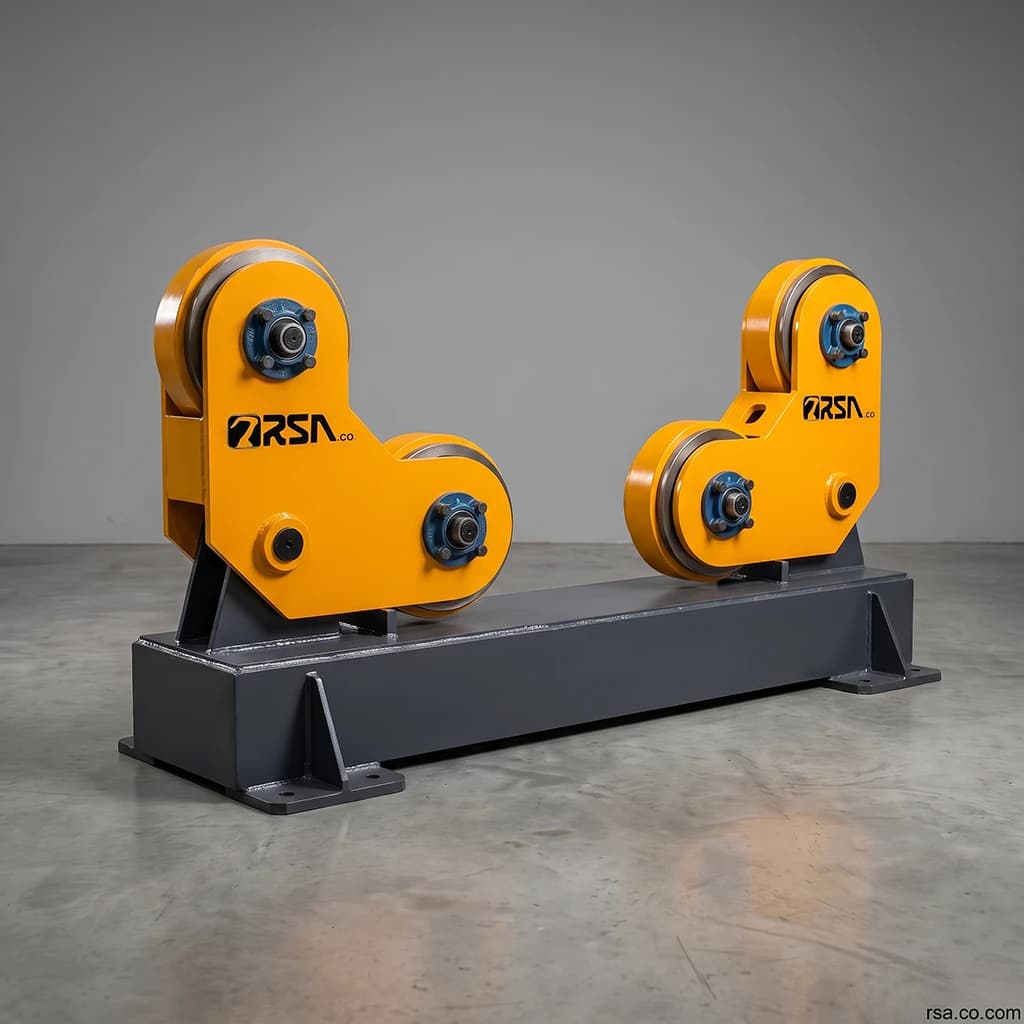
Industrial equipment
Self-Aligning Welding Rotator
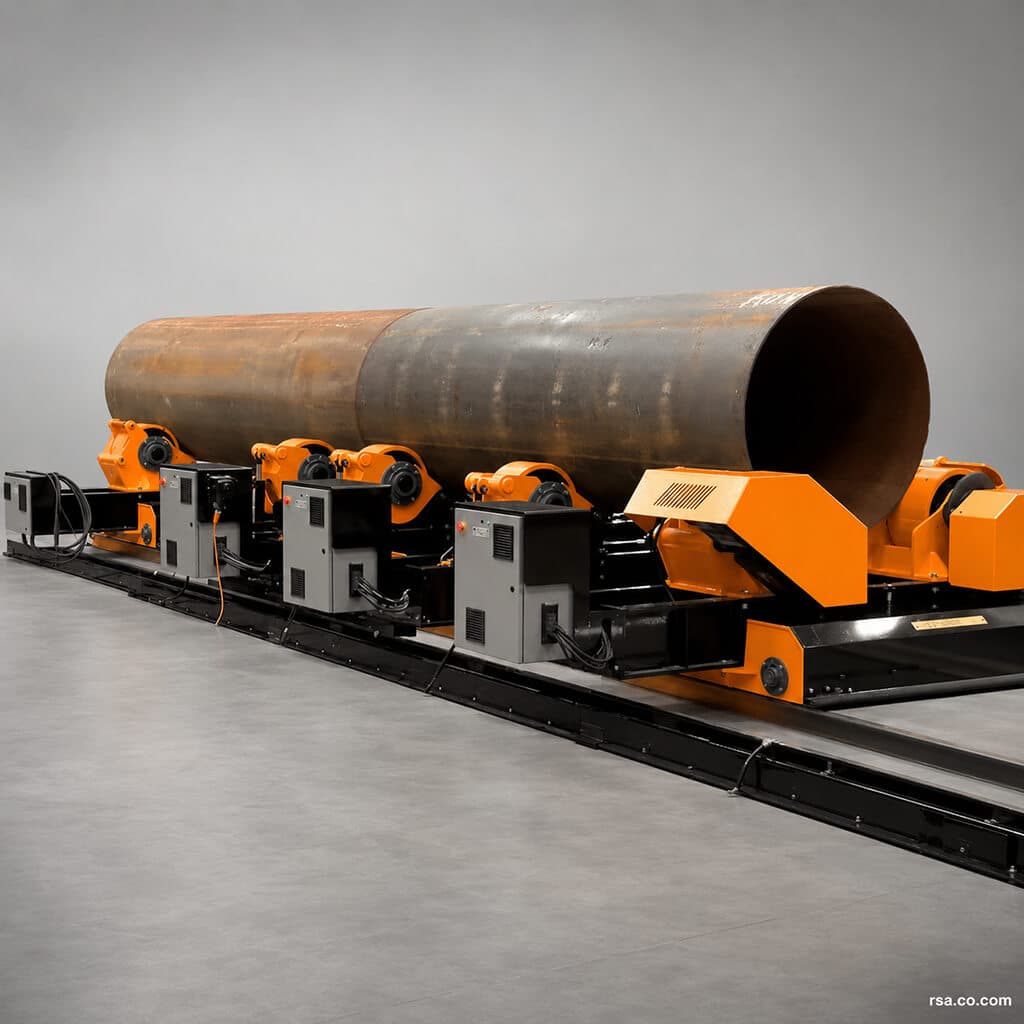
A self-aligning rotator supports and turns vessels, pipes, and other cylindrical workpieces. Its roller assemblies adjust mechanically to different diameters within the machine’s specified range, reducing changeover time.
Talk to an engineerFull description
A self-aligning welding rotator supports and turns vessels, pipes, and cylindrical workpieces during fabrication, assembly, and welding. Unlike a manual-adjustment rotator, its roller spacing does not normally have to be reset by hand whenever the workpiece diameter changes. The roller assemblies reposition under the loaded vessel within the machine’s designed diameter range. This can shorten setup and changeover time in lines handling many vessel sizes. RSA can design rotators in different capacities and dimensions for a project.
Self-Aligning Rotator Features
- No routine manual roller-spacing adjustment when changing to another supported vessel diameter.
- Rigid frame designed for loading loads and impacts.
- Capacity and dimensions tailored to the project.
- Wear-resistant polyurethane-coated rollers where suitable.
- Optional hardened steel rollers for very heavy applications.
- Coordinated drive assemblies for steady rotation.
- Inverter-based rotation speed adjustment.
- Wired remote control with a 6-metre cable in the described configuration.
- Integration with manual or automatic welding equipment.
- Applications in vessel, pipe, petrochemical, refinery, and power-plant fabrication.
Technical Specifications
Choose a model using actual workpiece weight, diameter range, vessel length, loading conditions, and process requirements. The following values are those listed for RSA’s model range.
| Model | Capacity | Rotation speed | Roller surface | Max D1 | Min D2 | Min D3 | T.P. |
|---|---|---|---|---|---|---|---|
| RBS20 | 20,000 kg | 14–60 cm/min | PU | Ø5,500 mm | Ø1,500 mm | Ø1,000 mm | 20,000 N |
| RBS40 | 40,000 kg | 12–60 cm/min | PU | Ø7,000 mm | Ø2,000 mm | Ø1,400 mm | 50,000 N |
| RBS70 | 70,000 kg | 12–60 cm/min | PU | Ø7,000 mm | Ø2,000 mm | Ø1,400 mm | 80,000 N |
| RBS100 | 100,000 kg | 15–60 cm/min | PU | Ø7,500 mm | Ø1,500 mm | Ø1,500 mm | 110,000 N |
| RBS150 | 150,000 kg | 15–60 cm/min | PU | Ø9,000 mm | Ø1,600 mm | Ø1,600 mm | 170,000 N |
| RBS250 | 250,000 kg | 15–60 cm/min | Hardened steel | Ø10,000 mm | Ø2,000 mm | Ø2,000 mm | 280,000 N |
Machine Dimensions
| Model | A (mm) | B (mm) | C (mm) | D (mm) | E (mm) | F (mm) | H (mm) | K (mm) |
|---|---|---|---|---|---|---|---|---|
| RBS20 | 950 | 650 | 100 | 1,880 | 300 | 1,680 | 980 | Ø360 |
| RBS40 | 1,000 | 650 | 150 | 2,480 | 390 | 2,000 | 1,220 | Ø360 |
| RBS70 | 1,200 | 800 | 240 | 2,500 | 430 | 2,000 | 1,140 | Ø400 |
| RBS100 | 1,250 | 800 | 260 | 2,690 | 460 | 2,200 | 1,270 | Ø400 |
| RBS150 | 1,380 | 950 | 280 | 3,000 | 510 | 2,460 | 1,440 | Ø500 |
| RBS250 | 1,560 | 950 | 220 | 3,580 | 630 | 2,930 | 1,670 | Ø550 |
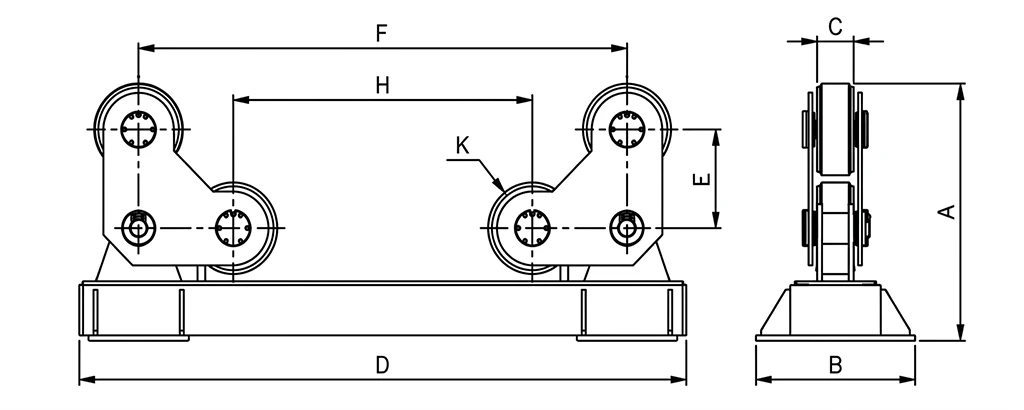
Read dimensions A through K together with the dimensional drawing for the relevant model.
What Is a Self-Aligning Welding Rotator?
A welding rotator turns a cylindrical workpiece about its longitudinal axis. In large-vessel circumferential welding, turning the workpiece at a controlled speed can be easier than moving the welding operator or equipment around it. In a self-aligning model, roller groups reposition as a vessel of a different diameter is loaded, eliminating the usual manual spacing adjustment for supported diameters.
How Does the Self-Aligning Mechanism Work?
Self-alignment is normally mechanical. In common designs, roller sets are mounted on pivoting assemblies. Vessel weight and diameter move those assemblies into positions suited to the cylindrical surface. The term does not necessarily imply sensors or computer-controlled adjustment.
- The roller assemblies carry the workpiece weight.
- The pivoting mechanism accommodates its diameter.
- The drive unit turns its powered rollers.
- Friction between rollers and vessel rotates the workpiece.
- The control system sets surface speed for the welding or assembly operation.
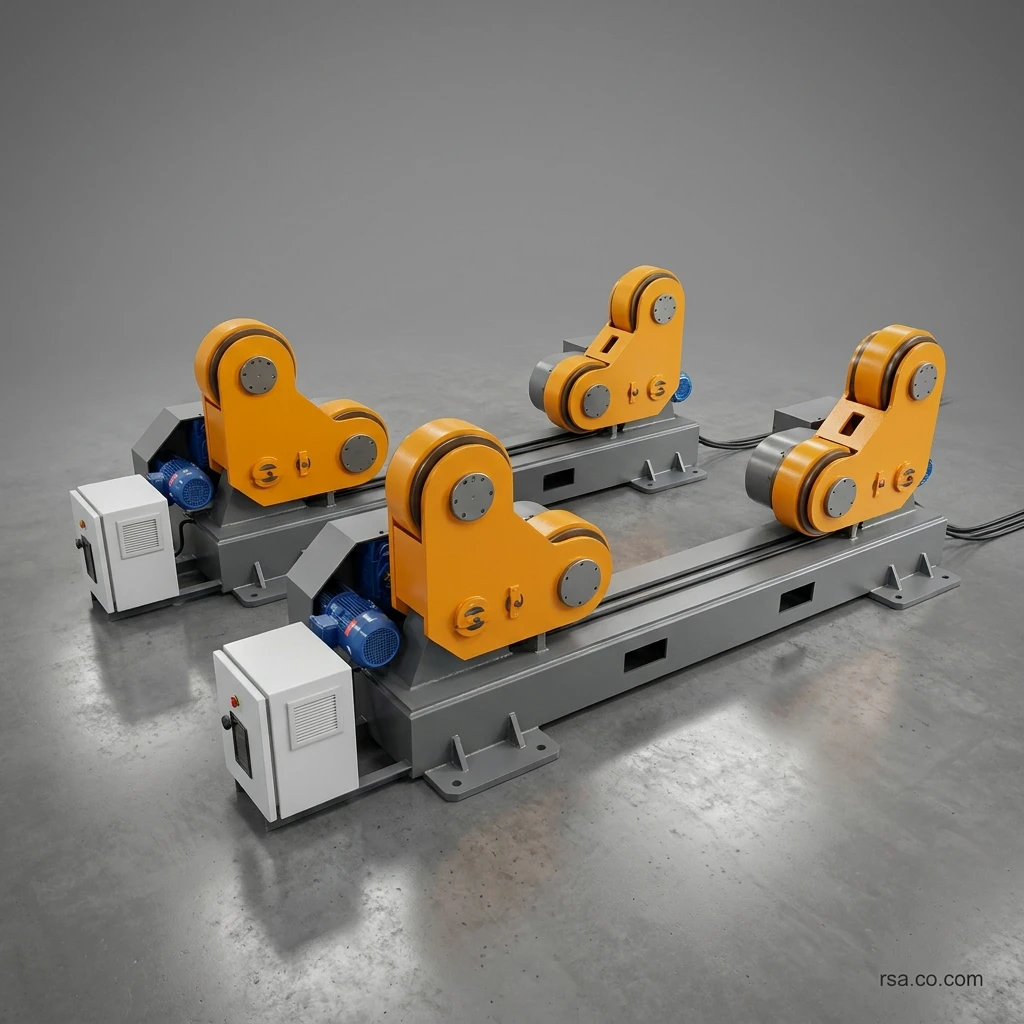
Drive and Idler Units
Drive unit
The drive unit supplies torque to rotate the vessel. Depending on design, it contains an electric motor, gearbox, transmission, powered rollers, speed control, electrical cabinet, and remote control. Torque and drive design are especially important when starting and turning a heavy workpiece.
Idler unit
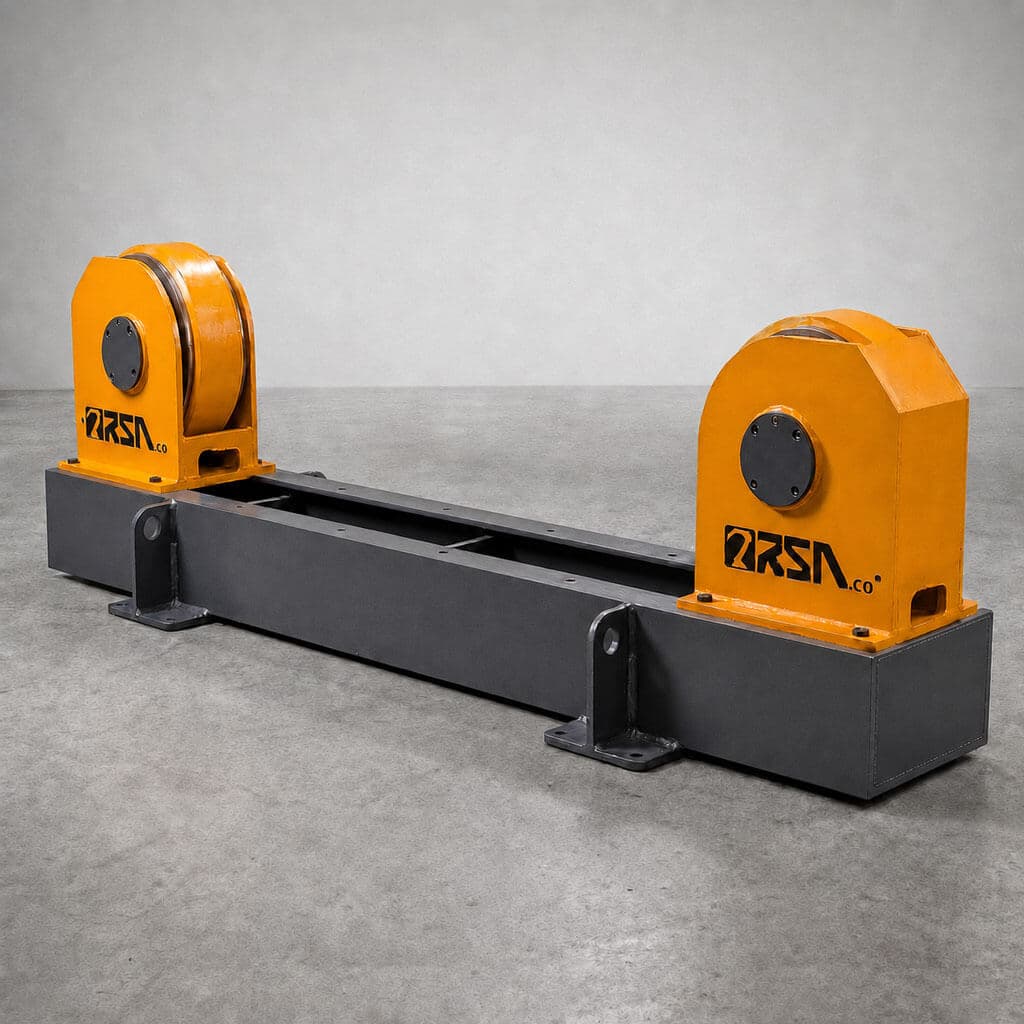
An idler supports the vessel and turns freely alongside the drive unit. A common rotator set contains one drive and one idler unit. Long workpieces or unusual load distributions may require more supporting units based on engineering calculations.
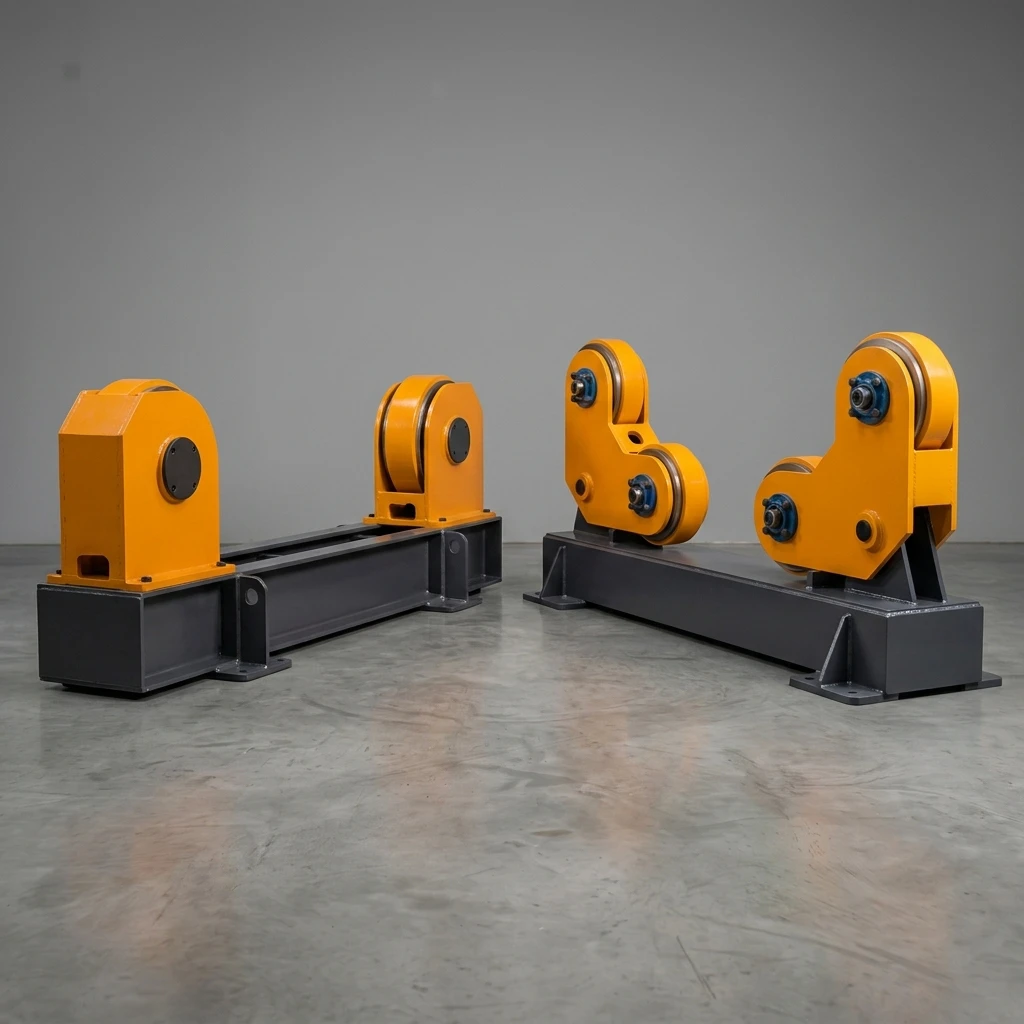
Self-Aligning Versus Manual-Adjustment Rotators
| Feature | Self-aligning rotator | Manual-adjustment rotator |
|---|---|---|
| Roller position change | Automatic mechanical response | Set by operator |
| Adjustment when diameter changes | Usually unnecessary within designed range | Required |
| Setup with frequent diameter changes | Shorter | Longer |
| Mechanical construction | More complex | Simpler |
| Production with varied diameters | Well suited | Suitable |
| Long production runs at one diameter | Suitable | Very suitable |
| Initial cost | Usually higher | Usually lower |
Self-aligning systems can shorten changeover when diameters change frequently. Where one diameter is processed for long periods, a manual-adjustment rotator may be an appropriate, lower-cost choice. The correct choice depends on the production process.
Adjustable Rotation Speed and Remote Control
A variable-frequency drive (VFD) can adjust motor and vessel speed to suit the process, particularly circumferential welding where surface speed must match welding parameters. Forward, reverse, and stop commands can also be made available. A wired remote with a 6-metre cable may provide these functions, speed adjustment, and an emergency stop when specified. Cable length and controls can be tailored to the project.
Roller Materials
Polyurethane-coated rollers
Wear-resistant PU coatings can provide an appropriate contact surface in suitable capacity ranges.
Steel rollers
Steel rollers may be specified for some very heavy applications. Selection is based on surface condition, load per roller, operating conditions, and the overall design, not workpiece weight alone.
Thin-Walled Vessels
A multi-roller arrangement can distribute load over more support points and may help some thin-walled vessels. Structural calculations and shell deformation limits are still required. Self-alignment alone does not guarantee that a thin shell can be rotated without distortion.
Applications
- Fabrication and circumferential welding of pressure vessels.
- Oil, gas, refining, and petrochemical vessels and process equipment.
- Large-diameter pipe production and welding.
- Boilers and other cylindrical power-plant equipment.
- Wind turbine tower sections where the machine suits the section geometry and load.
- Storage vessels.
- Certain marine and heavy-steel cylindrical fabrications.
Circumferential Welding and Column-and-Boom Integration
For circumferential welding, the torch or operator can remain near the joint while the rotator turns the vessel at a controlled speed. The rotator can be part of a mechanized cell with submerged arc welding (SAW), a welding manipulator, a column and boom, or other welding automation. The rotator positions the workpiece, the column and boom positions the welding head, and the welding system performs the weld. Rotation speed and welding parameters must be coordinated.
Does Self-Alignment Prevent Axial Drift?
No. Self-alignment means that the roller mechanism adapts to workpiece diameter. Axial drift or creep is gradual movement of the vessel along its length and is a separate issue. It may require precise drive/idler alignment, correct installation, review of workpiece geometry, or a dedicated anti-drift system. Where drift control is essential, it must be specified independently.
Can It Rotate Non-Circular Workpieces?
Welding rotators are principally designed for vessels, pipes, and rotationally symmetric parts. Some self-aligning systems may tolerate a specified amount of taper, diameter variation, or geometric irregularity, but not every non-round part. Check surface condition, ovality, diameter change, center of mass, and geometry before loading.
Selecting the Right Capacity
- Maximum total workpiece weight and its distribution between drive and idler units.
- Minimum and maximum diameter within the designed roller geometry.
- Workpiece length and the number of required support points.
- Required surface speed for the welding or assembly process.
- Surface sensitivity and suitable roller material.
- Temperature, dust, humidity, installation conditions, and available electrical supply.
- Compatibility with other equipment if part of an automatic welding line.
When Is a Self-Aligning Rotator a Good Choice?
It is most useful when workpiece diameters change regularly, reducing changeover time matters, and the line handles a variety of vessels or pipes. It can also form part of a mechanized welding cell. If production stays near one diameter and changeovers are rare, a manual-adjustment rotator may be simpler and less expensive.
How Is It Different from a Fit-Up Rotator?
A self-aligning rotator supports and turns a workpiece while adapting its rollers to the diameter. A fit-up rotator is designed to position and align two or more vessel sections before final welding, often using hydraulic movements. A self-aligning rotator does not automatically replace the fit-up equipment needed to join sections accurately.
Safe Operation and Maintenance
Before operation, check the rated capacity, rollers, mechanical joints, power and controls, drive/idler alignment, workpiece centering, emergency stop, motor, and gearbox. Never exceed the rated workpiece capacity. Follow the manufacturer’s operating instructions and lifting plan.
Inspect roller surfaces and PU wear, fasteners, bearings, motor, gearbox, transmission, cables, cabinet, remote, speed control, and any unusual vibration or noise on a schedule based on the installed components. Select gearbox oil and replacement intervals from the gearbox manufacturer’s instructions rather than assuming one interval fits every model.
Custom Manufacture, Support, and Pricing
Actual projects vary in weight, diameter, length, required rotation speed, and environment. RSA can design the frame, drive, roller material, speed controls, and support arrangement for the workpiece and production process. Services include technical consultation, custom design and manufacture, quality warranty, and technical and after-sales support.
Price depends on capacity, diameter range, structure, drive power, motor and gearbox, roller material and dimensions, control system, number of drive and idler units, customization, and site conditions. Provide minimum and maximum workpiece weight and diameter, length, material, required speed, welding process, loading method, site conditions, electrical supply, and accessory requirements for an accurate proposal.
Frequently Asked Questions
What is a self-aligning welding rotator?
A rotator for vessels, pipes, and cylindrical parts whose roller mechanism mechanically adapts to different diameters within its designed range.
How does it differ from a manual-adjustment rotator?
A manual model requires the operator to reposition its rollers when diameter changes. The self-aligning mechanism changes position under the newly loaded workpiece.
Can it handle every vessel diameter?
No. Each model has specified minimum and maximum working diameters.
What capacities are available?
The models listed here run from RBS20 at 20 tonnes to RBS250 at 250 tonnes.
Is rotation speed adjustable?
Yes, on models equipped with an inverter, within their designed speed range.
Is a remote control available?
The described models can be equipped with a wired remote and a 6-metre cable; options can be adapted to the order.
Can it be used for automatic welding?
Yes, provided the rotator design and controls are coordinated with equipment such as a column and boom or SAW system.
Does self-aligning mean anti-drift?
No. Diameter adaptation and axial drift control are separate features.
What information is needed to select a model?
Provide maximum weight, diameter range, vessel length, required rotation speed, process, and site conditions.
Summary
The principal advantage of a self-aligning welding rotator is its mechanical adaptation to vessel diameter without routine manual roller-spacing changes. This can simplify loading and reduce setup time where diameters vary. The correct model and any custom equipment must be selected from the actual workpiece weight, diameter, geometry, and operating requirements.
Comments (0)
No comments yet.
Leave a comment
Comments and replies appear after moderator review.