
Industrial equipment
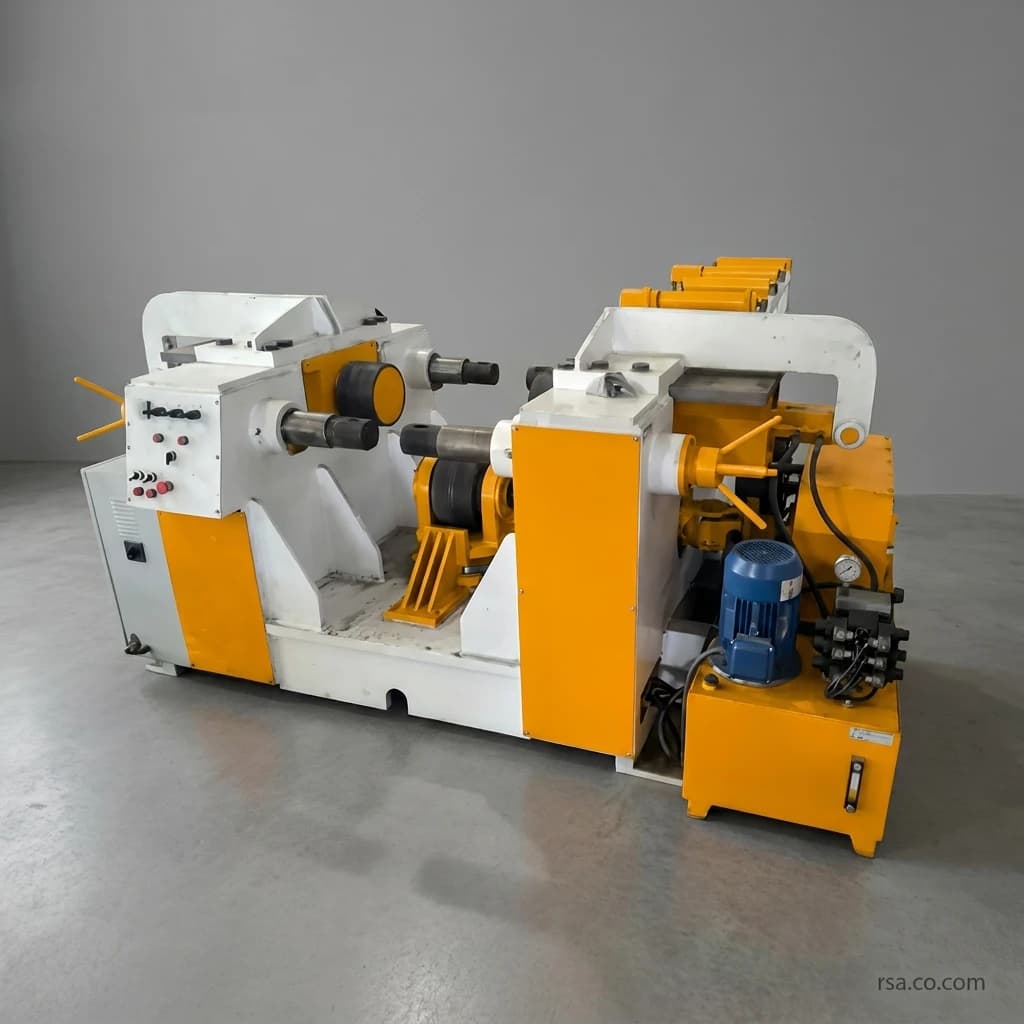
H-Beam Straightening Machine
An H-beam straightening machine corrects flange warping and distortion after beam assembly and welding. Controlled force restores dimensional accuracy and prepares the beam for the next production steps.
Talk to an engineerFull description
An H-beam straightening machine is an important finishing machine in welded plate-girder and structural-steel production lines. It corrects distortion in the flanges of welded H beams after fabrication.
Welding the web to the flanges introduces localized heat. Uneven heating and cooling can bend or wave the flanges or change their angle. If left uncorrected, the beam may fall outside the required dimensional tolerances. Controlled straightening returns the beam closer to a uniform profile, improves production accuracy and reduces manual rework.
RSA designs and builds H-beam straightening machines around customer beam dimensions, production capacity and line requirements.
What Is an H-Beam Straightening Machine?
Also called an H-beam flange straightener, this machine is a finishing stage for fabricated H beams. The welded beam consists of a web and two flanges. Welding heat can leave residual stresses and deform the flanges. The machine guides the beam through straightening rollers and applies mechanical or hydraulic pressure to restore flange geometry while avoiding unnecessary damage to the web or other areas.
Why Do H-Beam Flanges Distort After Welding?
Welding heats the web-to-flange joint locally. Steel expands when heated and contracts as it cools. Uneven heat distribution produces uneven contraction, which can cause:
Bent or warped flanges
A changed angle between web and flange
Wavy flange surfaces
Deviation from a straight line
Reduced dimensional accuracy
Dimensions outside manufacturing tolerances
The amount of distortion depends on plate thickness, steel grade, welding method, heat input, travel speed, welding sequence and beam size. Manual correction becomes harder, slower and riskier as beams and plates become larger.
How Does the Machine Work?
After welding, the H beam enters the machine between guide and straightening rollers. Rollers support it and apply controlled pressure to the deformed flange as the beam travels through. A typical process is:
Place the beam at the machine inlet
Align it with the rollers
Set the beam and flange dimensions
Set mechanical or hydraulic straightening force
Feed the beam through at a controlled speed
Straighten the flanges progressively
Check beam dimensions and straightness at the outlet
Set pressure according to steel grade, flange width and thickness, and the amount of distortion. Too little pressure will not correct the beam; too much can reverse the deformation or damage it.
Main Machine Components
Frame and Main Body
A rigid frame must resist vibration, bending and deflection under straightening force. Heavy steel plates and sections are typically fabricated, machined and checked dimensionally to support accuracy and service life.
Straightening Rollers
The rollers contact the beam directly and must resist pressure, impact and wear. Their shape, diameter, material and layout match the intended beam range. Roller surfaces should distribute pressure without damaging the beam.
Beam Drive
A motor, gearbox, couplings, chains, gears or other mechanical components move the beam through the rollers. Correct drive selection provides smooth travel without sudden shocks during straightening.
Pressure System
Straightening force can be applied mechanically or hydraulically. Hydraulic cylinders and a power unit offer easier force adjustment across varied flange thicknesses. Mechanical designs typically use power screws, gearboxes or other mechanisms to set roller position.
Guides and Beam Alignment
Guide rollers keep the beam correctly positioned as it enters and passes through the machine, limiting sideways drift or unintended rotation. Guidance is especially important for long, heavy beams.
Electrical Cabinet and Controls
The electrical system controls movement, speed, emergency stop and other functions. Depending on the automation level, controls may range from a simple panel to PLC and industrial display, allowing operating parameters to be set and monitored.
Machine Types
Mechanical H-Beam Straightener
A mechanical model sets roller position and force through mechanical mechanisms. It can suit lines with a defined beam and thickness range and may be simpler to maintain, although pressure adjustment can be less flexible.
Hydraulic H-Beam Straightener
Hydraulic cylinders generate the straightening force. Better force control and faster adjustment can suit heavier beams or lines handling varied dimensions and thicknesses.
Automated H-Beam Straightener
Automated configurations may include a PLC, sensors, encoders and operator display. Some setup, feed and pressure-control tasks can then be automated to improve repeatability and reduce dependence on manual adjustments.
Applications
The principal application is correction of welded H-beam flanges. The equipment can serve plate-girder production, structural-steel plants, industrial buildings, bridges, heavy columns and beams, oil and gas facilities, power plants, refinery structures, heavy industrial equipment, infrastructure projects and custom steel fabrication.
In a production line it may work alongside H-beam assembly equipment, submerged-arc welders, column-and-boom manipulators, rotators and transfer systems.
Benefits
Better Dimensional Accuracy
Correcting flange warp brings a beam closer to its intended profile and tolerances, simplifying later fabrication, site assembly and connection to other structural members.
Faster Throughput
Continuous machine straightening can be faster and require less manual labor than correcting each beam by hand, helping the overall line process more beams.
More Consistent Results
Controlled roller movement and force can reduce variation caused by manual technique and operator experience.
Less Scrap and Rework
Accurate correction can bring out-of-tolerance beams back into specification and reduce repeat work and wasted plate material.
Easier Subsequent Assembly
Straight beams make drilling, plate attachment, bracing and final welds more accurate and predictable.
Improved Workshop Safety
Manual correction of heavy beams with jacks, hammers, localized heat or temporary tools may expose operators to significant hazards. A purpose-designed machine reduces direct handling when operated correctly.
Lower Operating Costs
Although the machine requires an initial investment, lower labor demand, scrap, rework and production time can reduce longer-term operating costs.
Manual Straightening Versus Machine Straightening
Heat, impacts, jacks or other tools can be used for limited corrections or low-volume work. For industrial throughput, manual correction is slower, labor-intensive and harder to control consistently along the full beam length. A straightening machine applies repeatable, adjustable pressure and handles successive beams more efficiently.
What Makes a Suitable H-Beam Straightener?
Motor power or external size alone is not enough. Check frame stiffness, roller quality, force capacity for the flange thickness, adjustment for different widths, smooth feed, pressure control, maintenance access, safety equipment, electrical design, speed adjustment, mechanical and hydraulic component quality, customization and installation and parts support. The structure, rollers, controls and real production capacity must work together.
Selection Considerations
Beam Dimensions
Specify minimum and maximum web height, flange width and thickness, and beam length. Allow for plausible future products as well as today’s range.
Flange Material and Thickness
Required straightening force depends on flange thickness and width and steel grade. Size the machine for the most demanding beam expected in the line.
Production Capacity
Compare beams per shift and required line speed. The straightener should keep pace with upstream assembly and welding rather than becoming a bottleneck.
Mechanical or Hydraulic Force
A mechanical machine may suit a stable range of beam dimensions; hydraulic adjustment can offer more flexibility where thicknesses and sizes vary.
Automation and Support
Choose automation according to throughput, operator skills and budget. A PLC and HMI can simplify settings but add maintenance, training and replacement-parts considerations. Installation, training, servicing and parts support reduce long-term downtime risk.
Factors Affecting the Quotation
The configuration and quoted price depend on maximum flange width and thickness, straightening force, mechanical or hydraulic actuation, motor and gearbox, frame size, roller material, inlet and outlet conveyors, electrical controls, PLC and display, automation, safety systems, custom options and installation. Beam dimensions, steel grade and production targets are needed for an accurate quotation.
Custom Machine Design
Beam ranges, line layouts and throughput differ by factory. RSA can assess flange width and thickness, web height, required straightening force, pressure-system type, infeed and outfeed roller length, travel direction and speed, controls, automation, integration with existing machines, available floor space and workshop safety requirements. A project-specific design avoids unnecessary features and operating limitations.
Engineering Design Matters
The machine experiences substantial forces. Poorly sized frames, shafts, rollers or drives can vibrate, deflect, wear prematurely or lose accuracy. Engineering work must address force distribution, structural strength, bearings, shaft diameters, weld quality, machined surfaces and service access. Roller positions must apply force to the correct flange area without damaging the web.
Hydraulic System
Hydraulic models can generate high force with adjustable control. A typical system may include pump, reservoir, valves, gauge, filters, hoses and cylinders. Excess pressure can over-correct or damage a beam; insufficient pressure leaves distortion. Sound circuit design, quality components and regular oil and filter service are important for stable operation.
Maintenance and Servicing
Regular maintenance preserves accuracy, extends service life and reduces unplanned line stoppages. A service program should cover:
Roller condition and contact-surface wear
Lubrication of bearings and moving parts
Hydraulic-oil level and condition
Leaks in hoses and fittings
Hydraulic pressure
Chains, gears and couplings
Frame fasteners
Motor and gearbox operation
Electrical-cabinet cleanliness
Emergency-stop function
Sensor operation
Roller alignment
Recording service work and faults helps prevent recurring problems.
Operating Safety
Heavy beams, moving rollers and high forces require trained operators, suitable guards and clear procedures. Key precautions include:
Keep hands and tools out of roller nip points
Do not run with safety guards removed
Support and align the beam on the inlet rollers
Keep people clear of the beam travel path
Keep the emergency stop accessible
Stop the machine before mechanical adjustment
Isolate electrical power before repair
Wear appropriate workwear and protective equipment
Do not exceed the rated pressure or capacity
Replace worn parts promptly
Place in an H-Beam Production Line
Straightening is usually a late stage in welded H-beam production. A typical sequence is:
Cut web and flange plates
Transfer plates to assembly
Assemble and tack-weld the H beam
Complete web-to-flange welds
Transfer the beam to the straightener
Correct distorted flanges
Inspect dimensions and quality
Drill, attach plates or perform other finishing work
Coat and dispatch
The straightener must be sized to match assembly and welding throughput; otherwise beams accumulate before the correction stage.
Effect on Structural-Steel Quality
Warped or misaligned beams can fit poorly with columns, plates and other members on site, slowing erection and introducing unwanted stresses. Correcting geometry before dispatch improves appearance, installation accuracy and connection fit.
Why RSA?
RSA designs H-beam straighteners for the actual beam range, production duty and installation space. Available project options include mechanical or hydraulic actuation, a robust frame, capacity-matched components, automatic controls, inlet and outlet rollers, integration with the existing line, commissioning, operator training, technical service and spare parts.
After-Sales and Technical Support
Machine performance depends on correct installation, setup and support as well as build quality. Services can include pre-order assessment, beam review, project design, installation, initial adjustment, operator training, maintenance instructions, technical assistance, spare parts and troubleshooting.
Information Needed to Order
Send the manufacturer the minimum and maximum flange width and thickness, web-height range, usual beam length, steel grade, beams per shift, typical distortion, preferred actuation and automation, installation-space dimensions, line direction and the equipment before and after the straightener. These inputs help match machine capacity to the production line.
Frequently Asked Questions
Which part of the beam does it straighten?
It primarily corrects the flanges of welded H beams distorted by welding heat.
Can one machine process every H-beam size?
No. Every machine has a defined operating range for flange width and thickness, web height and material.
Is a mechanical or hydraulic model better?
The choice depends on beam dimensions, product variety, required throughput and control. Hydraulic models generally offer more adjustment flexibility.
Can it be custom built?
Yes. Beam range, production capacity, installation space and automation level can guide a custom design.
Does straightening damage the beam?
Proper roller design and pressure settings should correct the flange without significant surface or structural damage. The machine and settings must match the workpiece.
What determines the price?
Capacity, beam dimensions, pressure system, drive equipment, automation and custom options determine the quotation.
Summary
Welding heat can bend, wave or change the angle of H-beam flanges. An H-beam straightening machine applies controlled force to restore a more uniform profile. The right configuration can improve dimensional accuracy, reduce rework and scrap, speed production and support safer handling.
Selection should be based on flange dimensions, web height, steel grade, production volume, pressure system and automation needs. RSA can design and build a machine for the beam specifications and conditions of a particular structural-steel line. Share the beam range and line details to obtain technical information and a quotation.
Comments (0)
No comments yet.
Leave a comment
Comments and replies appear after moderator review.