
Industrial equipment
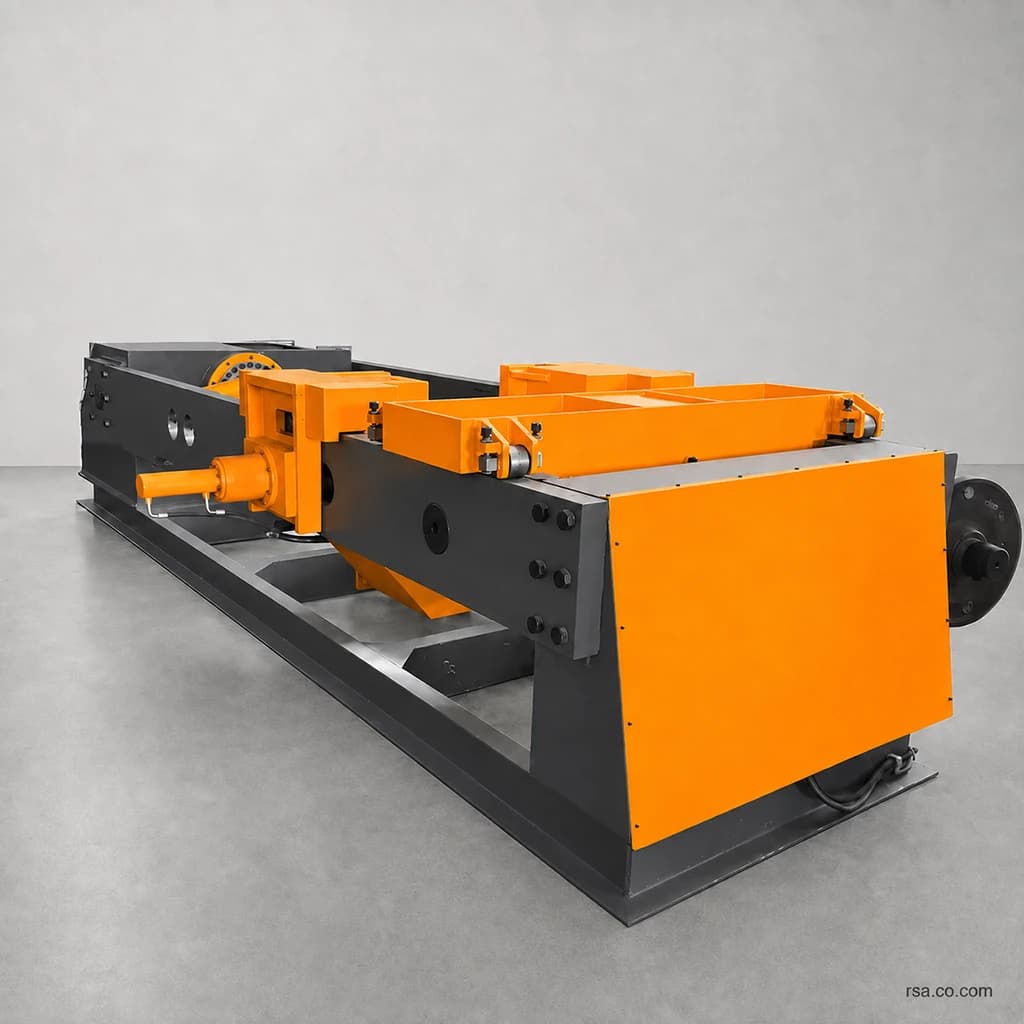
Horizontal Railway Wheelset Assembly Press
A hydraulic press for controlled assembly of railway wheels onto axles. Its rigid frame and alignment fixtures support precise, repeatable wheelset assembly.
Talk to an engineerFull description
The horizontal railway wheelset assembly press is specialized equipment for controlled installation of wheels onto the axles of trains, wagons, locomotives, and other rail vehicles. A wheelset typically has two steel wheels press-fitted onto an axle. Force control, alignment, and dimensional accuracy are essential throughout this operation.
With a horizontal layout and hydraulic force system, the machine supports the assembly of heavy rail components along a defined axis. Its design can be tailored to wheel size, axle length, required force, production volume, and the buyer’s preferred level of automation.
What Is a Horizontal Railway Wheelset Assembly Press?
This heavy industrial machine can be designed to press wheels, brake discs, and certain related components onto a railway axle. Hydraulic cylinders mounted on a rigid frame normally provide the force. Unlike a conventional vertical press, the axle and wheels lie horizontally along the assembly path, making long and heavy components easier to load, support, position, and inspect.
Depending on the project, the machine may be configured for:
- Pressing railway wheels onto axles.
- Assembling wagon wheelsets.
- Installing brake discs on an axle.
- Assembling certain gears and power-transmission components.
- Controlled removal of wheels or other axle-mounted parts.
- Recording force and displacement throughout the cycle.
- Checking the final position and spacing of the wheels.
Why Assembly Accuracy Matters
The wheel-and-axle assembly is a critical part of a rail vehicle. Reaching the final wheel position alone is insufficient: applied force, the force increase during travel, component displacement, and alignment must also meet the project’s engineering and quality requirements. Improper loading or positioning can damage mating surfaces, impair the joint, and cause rework. A properly designed press helps make assembly accurate, repeatable, and safer.
How the Horizontal Press Works
1. Load the axle and wheels
Place the axle on the machine supports and position the wheel or wheels with suitable lifting equipment. Supports and fixtures help align the wheel center with the axle.
2. Align the components
Check axle and wheel position before pressing. Proper coaxial alignment reduces side loading and the risk of damage to the mating surfaces. Position sensors and adjustment mechanisms can be added where greater control is required.
3. Begin the press operation
The hydraulic cylinder or cylinders apply force gradually and move the wheel along the specified assembly path onto the axle.
4. Monitor force and displacement
Where measuring equipment is installed, the control system records applied force and component movement. The force-versus-displacement relationship helps operators and inspectors assess the pressing cycle.
5. Stop at the specified position
The press stops when the wheel reaches the required position or another specified process limit. Inspect the final position, unload the wheelset, and perform any further measurements or tests required by the applicable assembly instructions.
Main Components
Frame and structure
The frame must withstand high pressing forces and the weight of the components. Structural stiffness and limited deflection help preserve assembly accuracy.
Hydraulic system
The hydraulic power system generates and controls force. It may include a pump, reservoir, control valves, pressure adjustment, filtration, pipework, and protective devices.
Pressing cylinders
One or more cylinders transmit the main force. Their arrangement, capacity, and stroke are selected for the required process and wheelset dimensions.
Axle supports and alignment fixtures
Supports hold the axle in position, while guides and fixtures align the wheel with its seat. Adjustable tooling can accommodate more than one axle design.
Force and position measurement
Depending on the specification, load cells, pressure sensors, linear scales, or displacement sensors can monitor the operation.
Electrical controls and safety equipment
The control cabinet and operator interface manage operation. PLC and HMI controls, guards, emergency stops, travel limits, and safety interlocks can be specified based on the project risk assessment.
Benefits of a Dedicated Wheelset Press
- Better control of force, speed, and final position than an uncontrolled assembly method.
- More consistent cycles across production and maintenance batches.
- Reduced risk of scratches, misalignment, and damage through proper support and gradual force application.
- Optional recording of force, displacement, and cycle outcomes for quality control and traceability.
- Easier support and handling of long axles and heavy wheels in a horizontal layout.
- Design tailored to the wheelset, production capacity, and plant infrastructure.
Applications
A horizontal wheelset press can be used in railway wheel and axle manufacturing, freight and passenger wagon production, locomotive plants, fleet maintenance workshops, wheelset refurbishment centers, metro facilities, and heavy transport equipment production. Depending on its tooling, a wheelset press may also install or remove brake discs, gears, and related axle components.
Force-Displacement Monitoring
An optional monitoring system plots pressing force against displacement using data from force and position sensors. This can reveal the force trend, flag unusual behavior, compare production cycles, document each wheelset, and support quality reports. Acceptance limits must be defined from the engineering drawings, assembly procedure, and quality requirements of the specific project.
Customization Options
- Nominal pressing force and hydraulic cylinder stroke selected for the project.
- Frame and supports sized to axle length and diameter and wheel diameter.
- One or two pressing units and adjustable positioning mechanisms.
- Integrated loading and unloading equipment.
- Manual, semi-automatic, or automatic operation with optional PLC and HMI.
- Force-displacement graphs, stored cycle data, reports, and programs for different products.
- Connection to a plant quality system.
- Project-specific guarding and safety equipment.
Technical Specifications
Final machine specifications are set after reviewing the components, production process, and buyer requirements. The table describes configurable fields; it does not state fixed capacity values.
| Item | Specification |
|---|---|
| Machine type | Horizontal railway wheel-and-axle assembly press |
| Force system | Hydraulic |
| Nominal pressing force | According to order |
| Maximum stroke | According to component dimensions |
| Axle length range | Customizable |
| Wheel diameter range | Customizable |
| Number of cylinders | According to design |
| Operating mode | Manual, semi-automatic, or automatic |
| Control system | PLC and HMI available |
| Force measurement | Available |
| Displacement measurement | Available |
| Process graph recording | Optional |
| Product data recording | Optional |
| Loading equipment | Can be designed for the project |
| Safety equipment | According to project risk assessment |
Selecting the Right Press
Wheel and axle dimensions
Wheel diameter, axle length, seat diameter, and assembly weight determine the frame envelope, supports, and required stroke.
Required assembly force
Determine the actual force from the joint design, tolerances, materials, and engineering procedure. A rough nominal figure alone may lead to inadequate capacity or unnecessary cost.
Production volume and operation
A semi-automatic system may suit limited production. Higher-volume lines may place more emphasis on loading speed, cycle time, and automatic records. Specify whether the machine must only assemble wheels or also remove wheels, brake discs, and other components.
Quality records and installation space
If traceability is required, define how part identifiers, graphs, timestamps, and cycle results are stored. Consider hall dimensions, overhead cranes, component travel paths, hydraulic power unit placement, and service access before finalizing the layout.
Why a Project-Specific Design?
Wheelset dimensions, required force, loading method, and quality rules vary by railway project. A custom design can optimize frame stiffness and size, hydraulic capacity, advance and return speeds, axle supports, wheel positioning, automation, process reporting, maintenance access, and operator safety for the actual production or repair line.
Maintenance
Preventive maintenance helps preserve machine accuracy and reliability. Inspect hydraulic oil level and condition, leaks at connections and cylinders, filters, hoses and pressure lines, sensors, force-measurement calibration, supports and fixtures, structural fasteners, and emergency stop equipment. Back up control programs and retain service records. Inspection intervals should reflect operating intensity, site conditions, and manufacturer instructions.
Information Required for an Order
- Wheel and axle drawings and component weights.
- Minimum and maximum wheelset dimensions.
- Required assembly and removal force.
- Target cycle time and production volume.
- Loading method and desired automation level.
- Data-recording and traceability requirements.
- Environmental and installation conditions.
After reviewing these inputs, the manufacturer can determine the machine capacity, component layout, hydraulic system, controls, and accessories for the production or maintenance line.
Summary
The horizontal railway wheelset assembly press applies controlled force while maintaining alignment and, where equipped, monitoring the process. A properly designed frame, hydraulic system, fixtures, measuring equipment, and controls can improve repeatability and reduce the risk of component damage. The machine should be specified around the actual wheelset dimensions, required capacity, production volume, and project quality requirements.
Comments (0)
No comments yet.
Leave a comment
Comments and replies appear after moderator review.